
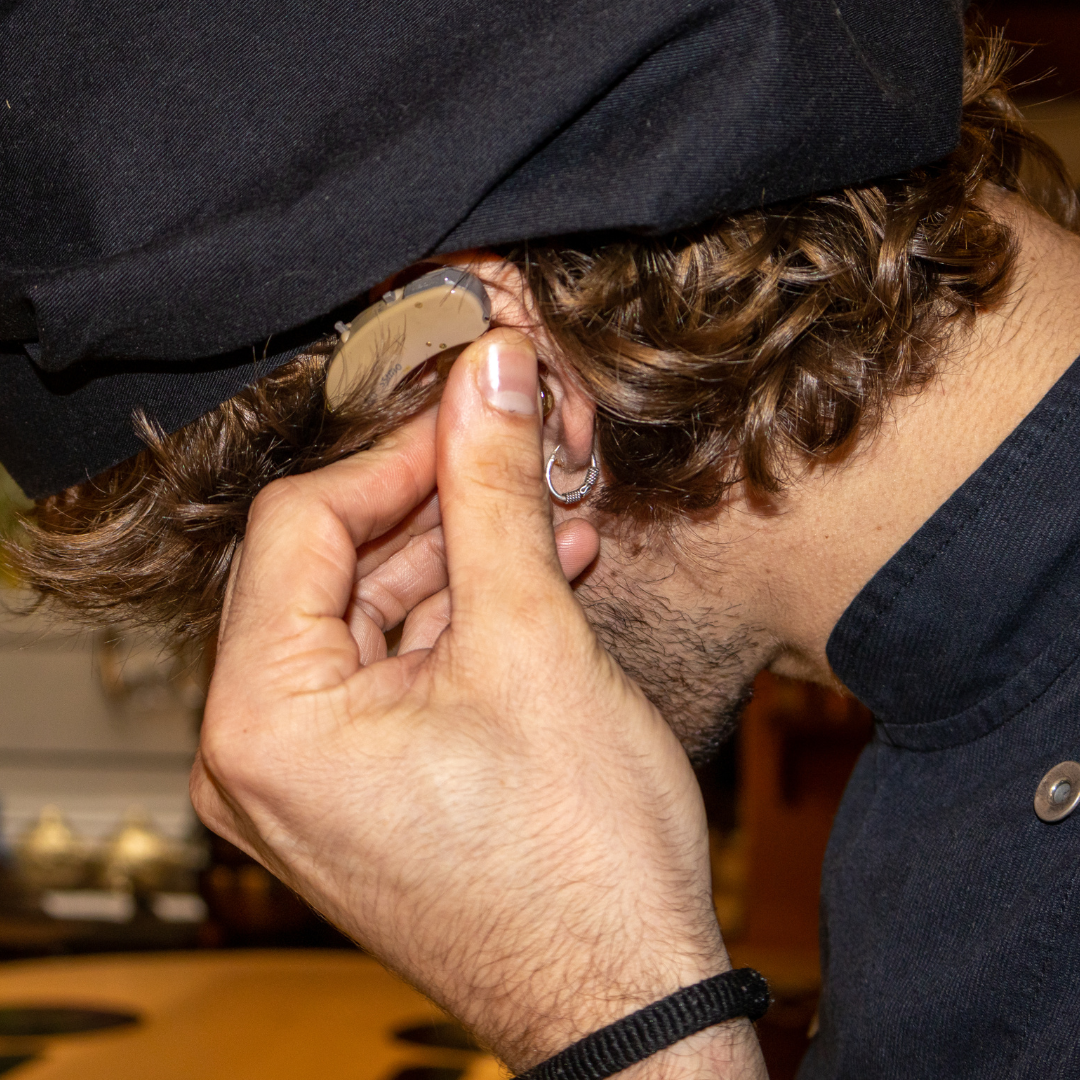
Maintaining dinner dialogue proves demanding when chaotic ambient noise strains your concentration and hearing. Our specialists can evaluate hearing under both calm and noisy listening conditions to establish why noisy rooms present such difficulty. After uncovering the precise factors driving your difficult hearing, our team helps you select individualized auditory solutions.
How Can Hearing Seem Normal at Home but Fail in a Restaurant?
Low-noise environments yield an advantageous signal-to-noise ratio where primary speech remains significantly louder than background sound. Restaurants create the opposite situation. Multiple voices, music, kitchen noise, and reverberation overlap with speech, forcing the ears and brain to work harder to separate the person you want to hear.
These communication barriers frequently indicate high-frequency hearing loss, central auditory-processing disorders, or age-related sensorineural changes. Dim lighting, physical tiredness, conversational distance, and divided attention exacerbate these listening deficits. Many individuals register normal audiometric thresholds on standard pure-tone screenings yet show profound deficits during speech-in-noise testing. Communication breakdowns in loud restaurants should be professionally assessed even if one-on-one listening feels uncompromised.
How Audiologists Identify High-Frequency Hearing Loss
Our diagnostic process starts with a detailed case history reviewing problematic listening scenarios, occupational noise exposure, tinnitus, ototoxic medications, and familial genetics.
Diagnostic pure-tone audiometry establishes the softest auditory thresholds you can perceive across standardized frequencies via air and bone conduction pathways. Sensorineural high-frequency hearing loss demonstrates an audiometric slope reflecting diminished hearing thresholds as sound frequencies climb. Comprehensive evaluations frequently include impedance tympanometry to examine middle-ear function and recorded word-recognition testing to measure speech understanding.
Since sound-treated booths cannot replicate the chaos of a crowded dining room, speech-in-noise testing provides critical real-world insight. The test assesses word and sentence discrimination as background acoustic competition intensifies. Combined, these clinical findings determine whether your symptoms stem from acoustic audibility, word clarity, central noise filtering, or multifactorial causes.
How Auditory Processing Difficulties Impact Adult Hearing
Auditory processing disorders interfere with the brain’s ability to process and decipher acoustic signals arriving from the ears. Even when the ears detect individual frequencies accurately, the central auditory system may falter at sorting overlapping voices, distinguishing close speech sounds, or processing fast-paced dialogue. Our clinical team starts by examining peripheral auditory thresholds, subsequently deciding if an auditory-processing test battery or multidisciplinary consultation is necessary.
Behavioral Strategies for Hearing Clearly in Loud Venues
Targeted behavioral changes optimize the acoustic speech signal reaching your auditory system while providing clear visual context. Before heading out to eat, select dining spots with quieter acoustic profiles or dine during low-volume hours. Establishments designed with high-walled booths, acoustic wall treatments, heavy fabrics, and carpeting reduce reverberation far better than modern industrial spaces with bare surfaces.
While seated at the restaurant:
- Request a table away from the kitchen, bar, speakers, and large groups.
- Position yourself with your back toward a solid partition to dampen intrusive background noise from behind.
- Position yourself directly opposite your companions where direct lighting highlights their facial expressions.
- Keep the distance between speakers as short as comfortably possible.
- Angle your stronger-hearing ear toward the primary individual you wish to converse with.
- Instruct conversational partners to reword missed phrases instead of repeating the entire sentence verbatim.
- Verifiably confirm essential conversational facts instead of bluffing comprehension.
- Take brief listening rests outside or in quiet hallways when mental fatigue emerges.
- Request that friends speak with crisp clarity rather than speeding through dialogue.
- Elevated yelling distorts auditory signals and seldom improves actual phonetic comprehension.
Advanced Technology for Hearing in Background Noise
Optimal technological solutions depend entirely on the etiology of your symptoms, target acoustic spaces, and whether measurable hearing loss exists. Customized hearing aids employ directional microphone beamforming, noise cancellation algorithms, and targeted dining programs to prioritize speakers in front while lowering ambient noise. Maintaining realistic expectations remains essential, as no auditory device can isolate conversation by removing all surrounding voices.
Remote wireless microphones offer an exceptional boost to the signal-to-noise ratio in challenging venues. Worn on the speaker’s collar or set on the table, the microphone broadcasts direct audio to paired hearing aids or specialized receivers. This reduces the effects of distance and surrounding noise.
Other useful options include:
- Dedicated table microphones engineered to capture small-group dialogue
- Built-in telecoils linking directly with induction hearing-loop systems in public venues
- Mobile device live-captioning programs and speech-to-text transcription software
- Consumer wireless earbuds or hearables featuring customizable assistive listening modes
- Sound-level or restaurant-review tools for finding quieter locations
We can compare options, confirm compatibility, and teach you how to use the selected device.
Clinical Audiology Care for Hearing in Complex Noise
Clinical hearing evaluations progress the diagnostic process past the typical assertion that hearing is adequate in quiet. Our audiology team assesses the unique environments, speaking partners, and ambient noise profiles that challenge you to choose targeted diagnostic tools. The diagnostic battery may encompass pure-tone thresholds, acoustic middle-ear evaluations, suprathreshold word recognition, and speech-in-noise measures. Specialized auditory-processing testing can be ordered when patient history and preliminary audiometric findings warrant deeper neural investigation.
Sudden unilateral hearing drops, acute asymmetric changes, or rapid auditory decline mandate evaluation by an ear, nose, and throat physician. Individualized diagnostic care pinpoints the precise physiological etiology rather than merely blaming restaurant noise for communication struggles.
Book Your Comprehensive Hearing Evaluation Now
If struggling through dinner conversation leaves you mentally exhausted, detached, or constantly guessing, schedule a complete hearing evaluation with our clinic. We can explore ways to help with hearing in noisy environments with hearing-aid adjustments, assistive tools, or rehabilitation options that may fit your needs.
Connect with us today to arrange your clinical visit and take the first step toward clearer, easier dining communication.